

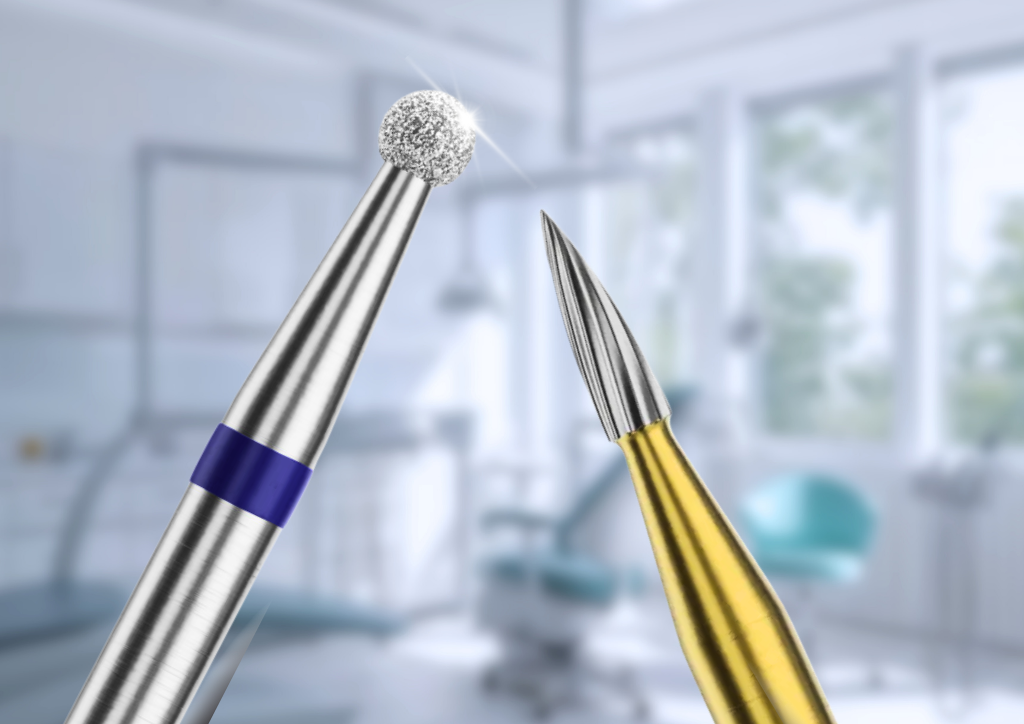
Choosing the right bur is essential for achieving precision, efficiency, and optimal clinical results in dental procedures. Among the most commonly used rotary instruments are diamond burs and carbide burs. Although both play a crucial role in daily clinical practice, they differ significantly in structure, cutting mechanism, and ideal indications.
Understanding these differences allows dental professionals to work more efficiently while preserving tooth structure and improving patient outcomes.
What Are Diamond Burs?
Diamond burs are coated with fine diamond particles bonded to a metal shank. Rather than cutting with blades, they grind the tooth structure through abrasion.
Advantages of Diamond Burs
- Excellent cutting efficiency on hard surfaces, such as enamel
- Provide smooth and uniform surface finishing
- Ideal for precision work and contouring
- Available in a wide variety of grits and shapes, allowing better control over surface texture
When to Use Diamond Burs
Diamond burs are best suited for:
- Tooth preparation for crowns, veneers, and inlays
- Reduction and contouring of enamel
- Finishing and smoothing restorative materials
- Procedures requiring high precision and surface refinement
They are especially effective when a controlled, gradual reduction is required, minimizing the risk of uneven surfaces.
What Are Carbide Burs?
Carbide burs are manufactured from tungsten carbide and feature sharp cutting blades (flutes). Instead of grinding, they cut the tooth structure, removing material more aggressively.
Advantages of Carbide Burs
- Faster material removal, especially in dentin
- Produce clean, precise cuts
- Generate less vibration during cutting
- Ideal for bulk reduction and removal of existing restorations
When to Use Carbide Burs
Carbide burs are recommended for:
- Removal of old restorations (amalgam, composites, metals)
- Cutting through dentin efficiently
- Sectioning crowns and bridges
- Endodontic access preparation
They are particularly useful when speed and efficiency are priorities, especially during initial cutting stages.
Diamond vs. Carbide: Which One Is Better?
Neither bur is “better” in all situations — they are complementary tools. In many procedures, the ideal approach is to use both, starting with carbide burs for rapid reduction and finishing with diamond burs for refinement and surface smoothing.
| Feature | Diamond Burs | Carbide Burs |
|---|---|---|
| Cutting Method | Abrasion | Bladed cutting |
| Best For | Enamel, finishing | Dentin, bulk removal |
| Speed | Moderate | High |
| Surface Finish | Smooth | Precise but rougher |
| Ideal Use Stage | Finishing & contouring | Initial cutting & removal |
Choosing the Right Bur for Better Results
Selecting the correct bur improves not only clinical efficiency but also the quality and longevity of restorations. By understanding the strengths of diamond and carbide burs, dental professionals can optimize each step of their procedures.
At Denfinity, we offer high-quality diamond and carbide burs designed to deliver performance, precision, and reliability — helping professionals achieve excellent clinical results every day.

Leave a Reply